

- Acceso abierto
- Catálogo 1.0
- Ciencias sociales y humanística
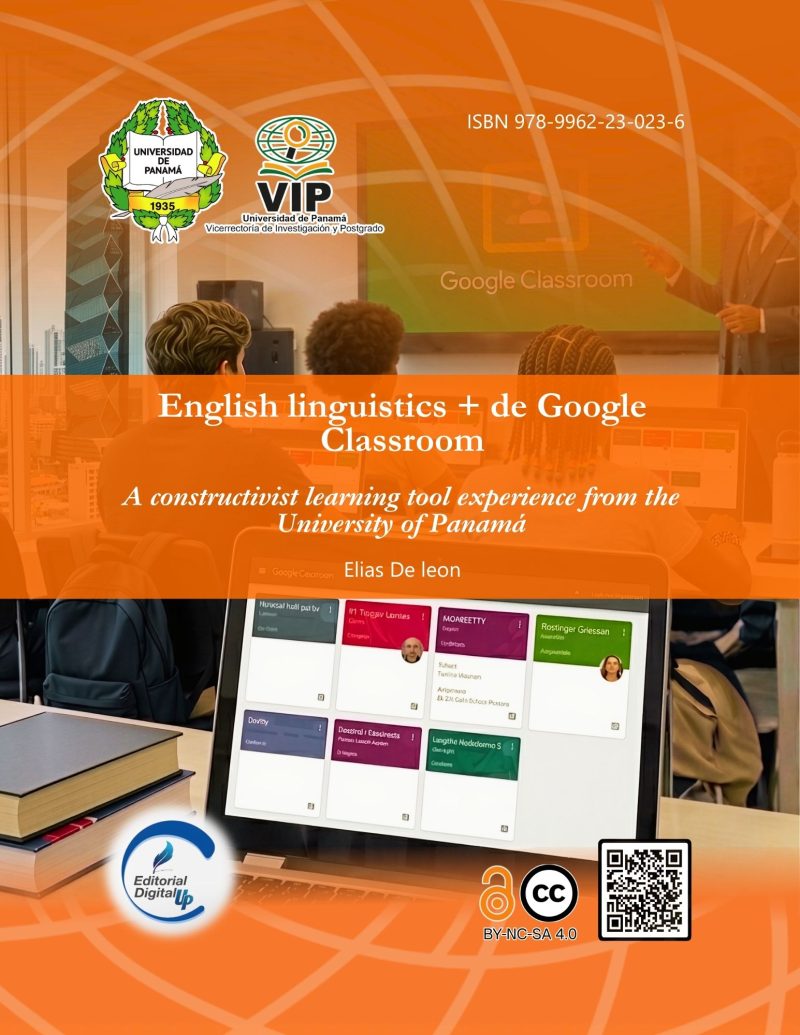
English Linguistics + Google Classroom A constructivist learning tool experience from the University of Panama
- Publicado
- 23 de noviembre de 2026
- ISBN
- 978-9962-23-023-6
- DOI
- 10.5281/
Descargas
Resumen
The use of virtual learning environments (VLEs) has been an inborn advance to the coverage of computer networks and the reality of the masses. The impossibility of face-to-face instruction after the unprecedented global health situation at the beginning of the second decade of the twenty-first century accelerated the avocation of higher education towards VLEs, and Panama did not escape this reality. At the University of Panama, under academic freedom, professors used countless digital tools to fulfill their mission of teaching. One of these digital tools, Google Classroom, allows the lesson content structure to emulate a VLE. This research aims to elucidate whether the use of Google Classroom as a virtual environment improved the learning of English in third-year students of the Introduction to English Linguistics course at the University of Panama, Octavio Méndez Pereira Campus, 2021. A modified COLLES survey is applied as measuring instrument to achieve the goal. To relate the data, Student’s t-test (with independent samples) is considered in assessing pretest-posttest and a Kendall correlation (tau-b) of the means and perceptual results given the low number of samples. It is concluded that the perception of knowledge is not related to Google Classroom, and it is demonstrated that its use as a virtual learning environment favors the learning of English in students.
English, Linguistics, virtual learning environment, Google Classroom, virtual learning
El uso de los entornos virtuales en el aprendizaje (EVA) ha sido un avance ingénito a la cobertura de las redes informáticas y la realidad de las masas. La imposibilidad de la instrucción presencial tras la inédita situación sanitaria mundial al inicio del segundo decenio del siglo XXI aceleró la avocación de la educación superior hacia los EVA y Panamá no escapó a dicha realidad. En la Universidad de Panamá, bajo la premisa de la libertad de cátedra, los profesores emplearon un sinnúmero de herramientas digitales para cumplir su misión de enseñar. Google Classroom, una de estas herramientas digitales, permite estructurar el contenido de las lecciones emulando un EVA. Esta investigación pretende esclarecer si el uso de Google Classroom como entorno virtual mejoró el aprendizaje del inglés en los estudiantes de tercer año del curso Introducción a la Lingüística Inglesa en la Universidad de Panamá, Campus Octavio Méndez Pereira, 2021. Para lograr la meta, se aplica una encuesta COLLES modificada como instrumento de medición. Para relacionar los datos, se considera la prueba T de Student (con muestras independientes) para valorar pretest-postest y una correlación de Kendall (Tau-b) de las medias y resultados perceptuales dado el bajo número de muestras. Se concluye que la percepción del conocimiento no guarda relación con Google Classroom y se demuestra que su uso entorno virtual de aprendizaje propicia el aprendizaje del inglés en los estudiantes.
Inglés, lingüística, entorno virtual de aprendizaje, Google Classroom, aprendizaje virtual.
Palabras clave
Cómo citar (APA 7)
De Leon, E. (2026). English Linguistics + Google Classroom: A constructivist learning tool experience from the University of Panama. Editorial Digital UP. https://doi.org/10.5281/
Referencias (110)
References
Adam, N. L., Alzahri, F. B., Soh, S. C., Bakar, N. A., & Kamal, N. A. (2017). Self-regulated learning and online learning: a systematic review. Proceedings of the International Visual Informatics Conference. Springer.
Alonso, C., Gallego, D., & Honey, P. (2007). Los estilos de aprendizaje. Mensajero.
Al-Samarrai, S., Gala, P., & Gangwar, M. (2020). The Impact of the COVID-19 pandemic on education financing. World Bank Group Education.
Alsina, J., Arguila, A., Aroztegui, M., Arroyo, J., Badia, M., Carreras, A., . . . Vila, B. (2013). Rúbricas para la evaluacíón de competencias. Cuadernos de Docencia Universitaria.
Altamirano, L. M. (2018). Propuesta metodológica de planificación curricular por competencias; una necesidad evolutiva en las prácticas pedagógicas en los sistemas educativos militares. Revista de Ciencias de Seguridad y Defensa, III(3), 13-27.
Anglin, L., Anglin, K., Schumann, P. L., & Kaliski, J. A. (2008). Improving the Efficiency and Effectiveness of Grading Through the Use of Computer‐Assisted Grading Rubrics. Decision Sciences Journal of Innovative Education, 6(1), 51-73. https://doi.org/https://doi.org/10.1111/j.1540-4609.2007.00153.x
Arancibia, V., Herrera, P., & Strasser, K. (2008). Manual de Psicología Educacional (6ta ed.). Santiago, Santiago, Chile: Ediciones Universidad Católica de Chile. Recuperado el 25 de abril de 2021
Arias. (1997). El proyecto de investigación. Carácas: Episteme.
Black, P., & Wiliam, D. (2006). Assessment and Classroom Learning. Assessment in Education: Principles, Policy & Practice, 5(1998), 7-74. https://doi.org/10.1080/0969595980050102
Borotis, S., & Poulymenakou, A. (2004). E-learning readiness components: Key issues to consider before adopting e-learning interventions. E-Learn: World Conference on E-Learning in Corporate, Government, Healthcare, and Higher Education (pp. 1622-1629). Association for the Advancement of Computing in Education (AACE).
Bozkirlia, K. C., & Er, O. (2021). Examination of attitudes towards e-learning of Turkish teacher candidates. Revista Argentina de Clínica Psicológica, 30(1), 753-759. https://doi.org/DOI: 10.24205/03276716.2020.2072
Broadbent, J. (2017). Comparing online and blended learner's self-regulated learning strategies and academic performance. The Internet and Higher Education, 33, 24-32.
Brookhart, S. M. (2015). The quality and effectiveness of descriptive rubrics. Educational Review, 67(3), 343-368. https://doi.org/https://doi.org/10.1080/00131911.2014.929565
Cañete, R., Guilhem, D., & Brito, K. (2012). Consentimiento informado: algunas consideraciones actuales. Acta bioethica, 18(1), 121-127. https://doi.org/http://dx.doi.org/10.4067/S1726-569X2012000100011
Clariana, M., Gotzens, C., del Mar Badia, M., & Cladellas, R. (2012). Procrastinación y engaño académico desde la Secundaria hasta la Universidad. Electronic Journal of Research in Educational Psychology, 10(27), 737-754. https://doi.org/10.25115/ejrep.v10i27.1525
Conniff, M. L. (2012). Panama and the United States: The End of the Alliance. Georgia Press.
Consejo General Universitario. (23 de abril de 2008). Reunión Extraordinaria N° 9-08. CGU.
Correa, J. S. (2014). Ferrocarriles y soberanía: el Ferrocarril de Panamá, 1850-1903. América Latina en la Historia Económica, 22(2). https://doi.org/ISSN 2007-3496
Council of Europe. (2001). Common European framework of reference for languages: Learning, teaching, assessment. University of Cambridge. Cambridge, U.K.: Press Syndicate of the University of Cambridge.
Council of Europe. (2020, October 15). Global scale - Table 1 (CEFR 3.3): Common Reference levels. Retrieved from CEFR 3.3 - Common Reference levels (Table 1): https://www.coe.int/en/web/common-european-framework-reference-languages/table-1-cefr-3.3-common-reference-levels-global-scale
Cruz, A. V., Silva Diéguez, O. R., Ferrer Cabonel, C. A., Saborit, G. A., Cuenta, A. F., Navarro Consuegra, M. A., & Cruz, S. G. (2010). Una alternativa desarrolladora para el aprendizaje del idioma inglés. Pedagogía Universitaria, 15(3), 12.
Cucinotta, D., & Vanelli, M. (2020). WHO Declares COVID-19 a Pandemic. Acta Biomed, 91(1), 157-160. https://doi.org/https://doi.org/10.23750/abm.v91i1.9397
Cull, S., Reed, D., & Kirk, K. (2010). Student motivation and engagement in online courses. In Authored as part of the 2010 workshop, Teaching Geoscience Online-A Workshop for Digital Faculty.
Davis, F. (1989). A technology acceptance model for empirically testing new end-user information systems : theory and results. MIS Quarterly, 13(1), 318-340. https://doi.org/https://doi.org/10.2307/249008
De Leon, E. (2022). Uso de Google Classroom como entorno virtual para mejorar el aprendizaje constructivista del inglés en los estudiantes del curso Introducción a la Lingüística Inglesa en la Universidad de Panamá, Campus Octavio Méndez Pereira, 2021. Epicentro, 1(2), 31-44. https://doi.org/10.61209/re.v1i2.21
Dewey, J. (1929). The Quest for Certainty. Minton.
EF Education First. (2020). EF English Proficiency Index. Stockholm: EF Education First.
ETS. (2020). TOEFL iBT - Test and Score Data Summary 2019. NJ: Educational Testing Service. Obtenido de https://www.ets.org/s/toefl/pdf/94227_unlweb.pdf
Fasano, G., & Franceschini, A. (1987). A multidimensional version of the Kolmogorov–Smirnov test. Monthly Notices of the Royal Astronomical Society, 225(1), 155-170. https://doi.org/https://doi.org/10.1093/mnras/225.1.155
Ferreira, C., & Serpa, S. (2018). Informed Consent in Social Sciences Research: Ethical Challenges. International Journal of Social Science Studies, 6(5), 13-23. https://doi.org/10.11114/ijsss.v6i5.3106
Fletcher, A., & Shaw, G. (2012). How does student-directed assessment affect learning? Using assessment as a learning process. Internationa Journal of Multiple Research Approaches, 6(2012), 245-263. https://doi.org/10.5172/mra.2012.6.3.245
Gaceta Oficial. (18 de marzo de 2003). Ley N° 18 QUE CREA EL PROGRAMA PANAMA BILINGUE Y DICTA OTRA DISPOSICION. Gaceta Oficial.
Gaceta Oficial. (14 de enero de 2003). Ley N° 2 QUE ESTABLECE LA ENSEÑANZA OBLIGATORIA DEL IDIOMA INGLES EN LOS CENTROS EDUCATIVOS OFICIALES Y PARTICULARES DEL PRIMER Y SEGUNDO NIVEL DE ENSEÑANZA Y DICTA OTRAS DISPOSICIONES. Gaceta Oficial.
Gaceta Oficial. (14 de diciembre de 2007). Sistema Nacional de Investigación de Panamá. Gaceta Oficial.
Gaceta Oficial. (13 de marzo de 2020). Consejo de Gabinete N° 11 QUE DECLARA EL ESTADO DE EMERGENCIA NACIONAL Y DICTA OTRAS DISPOSICIONES. Gaceta Oficial.
Gaceta Oficial. (2020, julio 2). Decreto Ejectutivo N° 564 Que establece el calendario escolar 2020 a distancia, no presencial, de manera transitoria, en centros educativos oficiales y particulares del primer y segundo nivel de enseñanza, del subsitema regular y no regular y dicta otras . Gaceta Oficial.
Gaceta Oficial. (2 de abril de 2020). Ley N° 139 Que adopta una ley general sobre medidas de emergencia para afrontar la crisis sanitaria causada por la pandemia del COVID-19. Gaceta Oficial.
Gaceta Oficial. (7 de julio de 2020). Ley N° 375 QUE PRORROGA LA VIGENCIA DE LA LEY 139 DE 2 DE ABRIL DE 2020 QUE ADOPTA UNA LEY GENERAL SOBRE MEDIDAS DE EMERGENCIA PARA AFRONTAR LA CRISIS SANITARIA CAUSADA POR LA PANDEMIA DEL COVID-19. Gaceta Oficial.
Gagne, R. M. (1962). The acquisition of knowledge. Psychological Review, 69(4), 355-356. https://doi.org/https://doi.org/10.1037/h0042650
Gardner, H. (2000). A Case Against Spiritual Intelligence. The International Journal for the Psychology of Religion, 10(1), 27-34. https://doi.org/https://doi.org/10.1207/S15327582IJPR1001_3
Gardner, H. (2011). Intelligence, Creativity, Ethics: Reflections on My Evolving Research Interests. Gifted Child Quarterly, 55(4), 302-304. https://doi.org/https://doi.org/10.1177/0016986211421873
Hanni, M. (2019). Financiamiento de la enseñanza y la educación y formación técnica y profesional en América Latina y el Caribe. Santiago: Comisión Económica para América Latina y el Caribe (CEPAL).
Hernandez-Sampieri, R., & Mendoza, C. P. (2018). Metodología de la investigación: Las rutas cuantitativa, cualitativa y mixta. Mexico: McGraw-Hill Education.
Hernández-Sampieri, R., Fernández Collado, C., & Babptista Lucio, M. (2014). Metodología de la Investigación. México D.F., México D.F., México: McGraw-Hill.
Hernández-Sampieri, R., Fernández-Collado, C., & Babtista-Lucio, P. (2017). Alcance de la Investigación. En R. Hernández-Sampieri, C. Fernández-Collado, & P. Babtista-Lucio, Metodología de la Investigación (6ta ed., págs. 88-101). Mexico: McGraw-Hill. Obtenido de http://metabase.uaem.mx/bitstream/handle/123456789/2792/510_06_color.pdf?sequence=1
Herrera, L. M. (2002). Las fuentes del aprendizaje en ambientes virtuales educativos. REencuentro. Análisis de Problemas Universitarios, 35, 69-74. Recuperado el 25 de Abril de 2021, de https://www.redalyc.org/articulo.oa?id=34003507
Hillman, D. C., Willis, D. J., & Gunawardena, C. N. (1994). Learner-interface interaction in distance education: An extension of contemporary models and strategies for practitioners. The American Journal of Distance Education, 8(2), 30-42.
Honey, P., & Mumford, A. (1986). The Manual of Learning Styles. Ardingly House.
INCEFI. (2016). La Eficiencia del Gasto Público en Educación y Salud en Panamá, 2003-2013. Instituto Centroamericano de Estudios Fiscales.
Jácome, M. D., & Moreno, D. G. (Mayo de 2015). Guía metodológica docente para trabajar los ejes transversales en los bloques curriculares de primer año de educación básica. Quito, Pichincha, Ecuador. Obtenido de https://dspace.ups.edu.ec/bitstream/123456789/9749/1/QT07531.pdf
Jácome, M. d., & Moreno, D. G. (2015). Guía metodológica docente para trabajar los ejes transversales en los bloques curriculares de primer año de educación básica (Bachellor's Thesis). Universidad Politécnica Salesiana. Obtenido de http://dspace.ups.edu.ec/handle/123456789/9749
Keskin, S., & Yurdugül, H. (2019). Factors Affecting Students’ Preferences for Online and Blended Learning:. European Journal of Open, Distance and E-Learning, 22(2), 71-85. https://doi.org/DOI: 10.2478/eurodl-2019-0011
Kolb, D. A. (1984). Experimental learning: experience as the source of learning and development. Englewood Cliffs, New Jersey, USA: Prentice Hall.
Kumeh, T. (2004). Education: Standardized test, explained. Obtenido de Standardized Tests: http://standardizedtests.procon.org/view.answers.php?questionID=00
Lavrakas, P. J. (2008). Significance Level. In Encyclopedia of survey research methods (Vols. 1-0). Thousand Oaks, CA: Sage Publications, Inc. https://doi.org/10.4135/9781412963947.n532
Littlejohn, A., Hood, N., Milligan, C., & Mustain, P. (2016). Learning in MOOCs: Motivations and self-regulated learning in MOOCs. The Internet and Higher Education, 29, 40-48.
MEDUCA. (2013). Memoria 2013. Ministerio de Educación Secretaría General.
Ministerio de Economía y Finanzas. (2021). MEF - Informe del Presupuesto Institucional 2020. (M. González, Ed.) Recuperado el 4 de April de 2021, de https://www.datosabiertos.gob.pa/: https://www.datosabiertos.gob.pa/dataset/mef-presupuesto-institucional-2020
Moore, M. G. (1989). Three types of interaction. The American Journal of Distance Education, 3(2), 1-7.
Moore, M. G., & Kearsley, G. (1996). Distance education: A systems view.
Morales, P., & Rodriguez, L. (2016). Aplicación de los coeficientes correlacion de Kendall y Spearman. Barquisimeto: Universidad Centrooccidental Lisandro Alvarado, UCLA.
Musmade, P. B. (2013). Informed consent: Issues and challenges. Journal of Advanced Pharmaceutical Technology & Research, 4(3), 134-140. https://doi.org/10.4103/2231-4040.116779
Nayafi, H., Rolheiser, C., Harrison, L., & Heikoop, W. (2018). Connecting Learner Motivation to Learner Progress and Completion in Massive Open Online Courses. Canadian Journal of Learning and Technology, 44(2).
Nunnally, J. C. (1967). Psychometric theory. McGraw-Hill.
Oliver, K. (2000). Developing Constructivist Learning on the Web. Educational Technology, 40(6), 5-18. Retrieved from https://www.jstor.org/stable/44428633
OPS. (2020). PAHO.ORG. (OPS) Retrieved from OPS Panamá: https://www.paho.org/pan/index.php?option=com_content&view=article&id=1349:panama-confirma-primer-caso-de-covid-19&Itemid=442
Ortiz, A., & Burdiles, P. (2010). Consentimiento informado. Revista Médica Clínica Las Condes, 21(4), 644-652. https://doi.org/https://doi.org/10.1016/S0716-8640(10)70582-4
Otzen, T., & Manterola, C. (2017). Técnicas de Muestreo sobre una Población a Estudio. International Journal of Morphology, 35(1), 227-232.
Palella Stracuzzi, S., & Martins Pestana, F. (2006). Metodología de la investigación cuantitativa. Caracas: Fedupel.
Park, J. H., Lee, E., & Bae, S. H. (2010). Factors influencing learning achievement of nursing. Journal of Korean Academy of Nursing, 40(2), 182-190.
Pauliková, K. (2018). Teaching speaking through dialogues, discussions, and role-plays. Slavonic Pedagogical Studies Journal, 201-214.
Penprase, B. E. (2018). The Fourth Industrial Revolution and Higher Education. En N. W. Gleason (Ed.), Higher Education in the Era of the Fourth Industrial Revolution. Singapore, Singapore, Singapore: Springer Nature Singapore Pte Ltd. https://doi.org/https://doi.org/10.1007/978-981-13-0194-0_9
Piaget, J. (1936). Origins of intelligence in the child. Routledge & Kegan Paul.
Piaget, J. (1952). Origins of intelligence in the child. W. W. Norton & Company. https://doi.org/10.1037/11494-000
Piaget, J. (1980). The psychogenesis of knowledge and its epistemological significance. London: Routledge & Kegan Paul.
Piaget, J., Inhelder, B., Sinclair, H., & Pomerans, A. J. (1973). Memory and Intelligence. London: Routledge and Kegan Paul.
Pintrich, P. R., Smith, D., Garcia, T., & McKeachie, W. (1991). A Manual for the Use of the Motivated Strategies for Learning Questionnaire. The University of Michigan.
Ramli, N., Muljono, P., & Afendi, F. M. (2018). The influencing factors of self directed. Jurnal Kependidikan: Penelitian Inovasi Pembelajaran, 2(1), 153-166.
Razali, N. M., & Wah, Y. B. (2011). Power comparisons of Shapiro-Wilk, Kolmogorov-Smirnov, Lilliefors and Anderson-Darling tests. Journal of Statistical Modeling and Analytics, 2(1), 21-33.
Resolución de Gabinete N° 1. (7 de January de 2021). Que aprueba el Plan Estratégico Nacional para el Desarrollo de la Ciencia, la Tecnología y la Innovación (PENCYT) 2019-2024. Panamá: Gaceta Oficial.
Rojas, G., Salas, R., & Jimenez, C. (2006). Estilos de aprendizaje y estilos de pensamiento entre estudiantes universitarios. Estudios Pedagógicos, 32(1), 49-75.
Rubin, A., & Babbie, E. (2017). Research Methods for Social Work (7th ed.). CA: Brooks/Cole-Cengage Learning.
Sahin, M., Keskin, S., Özgür, A., & Yurdugül, H. (2017). Determination of interaction profiles based on learner characteristics in e-learning environment. Educational Technology Theory and Practice, 7(2), 172-192. https://doi.org/doi: 10.17943/etku.297075
Scharager, J., & Reyes, P. (2001). Muestreo No-Probabilístico. Metodología de la Investigación. Santiago, Región Metropolitana, Chile: Escuela de Psicología - Pontificia Universidad Católica de Chile.
Schunk, D. (1989). Social Cognitive Theory and Self-Regulated Learning. Self-Regulated Learning and Academic Achievement, 83-110. https://doi.org/10.1007/978-1-4612-3618-4_4
SENACYT. (2019). Política Nacional De Ciencia, Tecnología e Innovación Panamá 2040 y Plan Nacional Estratégico De Ciencia, Tecnología e Innovación (PENCYT) 2019 – 2024: “Hacia la Transformación de Panamá”. Secretaría Nacional de Ciencia, Tecnología e Innovación. Panamá: SENACYT.
Serrano, D. (2020). La nación flotante: La inscripción de la casa, identidad y cultura de los afrodescendientes de Panamá. Academia Panameña de la Lengua.
Shroff, R. H., Vogel, D. R., & Coombes, J. (2008). Assessing Individual-level Factors Supporting Student Intrinsic Motivation in Online Discussions: A Qualitative Study. Journal of Information Systems Education, 19(1), 111-126.
Shroff, R. H., Vogel, D. R., & Coombes, J. (2008). Assessing Individual-level Factors Supporting Student Intrinsic Motivation in Online Discussions: A Qualitative Study. Journal of Information Systems Education, 19(1), 111-126.
Skinner, B. F. (1953). Science and human behavior. The Macmillan Company.
Subbotsky, E. (1996). Vygotsky's Distinction Between Lower and Higher Mental Functions and Recent Studies on Infant Cognitive Development. Journal of Russian & East European Psychology, 34(2), 61-66.
Taylor, P., & Maor, D. (2000). Assessing the efficacy of online teaching with the Constructivist On-Line Learning Environment Survey. Teaching and Learning Forum 2000. Perth: Curting University of Technology. Retrieved from https://researchrepository.murdoch.edu.au/id/eprint/8750/1/TL_Forum_2000__Taylor_and_Maor_-_the_Constructivist_On-Line_Learning_Environment_Survey.pdf
Terrádez, M. (2007). Los estilos de aprendizaje aplicados a la enseñanza del español como lengua extranjera. Foro de profesores E/LE(3), 227-230. Obtenido de https://dialnet.unirioja.es/servlet/articulo?codigo=4904031
Thompson, N. A. (2013). Reliability & Validity. Assessment Systems Worldwide.
Tinoco, B., Rodriguez, C., & De Leon, E. (2022). Análisis de recursos digitales utilizados por el cuerpo docente de la Escuela de Inglés durante el primer semestre del 2020. Catedra, 19(2022), 71–84.
Torres, M., Paz, K., & Salazar, G. (2019). Métodos de recolección de datos para una investigación. Boletín electrónico - Universidad Rafael Landívar, 3(1), 1-21. Obtenido de http://biblioteca.udgvirtual.udg.mx/jspui/handle/123456789/2817
UNCTAD. (2019). Panama Innovation Policy Review. Naciones Unidas. United Nations Conference on Trade and Development (UNCTAD). Obtenido de Examen de las Políticas de Ciencia, Tecnología e Innovación de Panamá: https://unctad.org/es/system/files/official-document/dtlstict2019d12_es.pdf
Universidad de Panamá. (2020, marzo 11). Acuerdo N° 320. Consejo Académico de la Universidad de Panamá.
Universidad del Sur. (2013). Técnicas de Investigación Educativa G38. (Doctorado en Educación del la Universidad del Sur - Grupo 38) Obtenido de Coeficiente Biserial de Punto: https://sites.google.com/site/tecnicasdeinvestigaciond38/estadisticas-no-parametricas/3-4-coeficiente-biseral-de-punto
Valenzuela, R. O., & Thomas, D. (2020). The Development of Academic English Language Learning Strategies and Academic Motivation among International University Students in Thailand. Human Behavior Development & Society, 98–107.
Vygotsky, L. (1967). Play and Its Role in the Mental Development of the Child. Soviet Psychology, 5(3). https://doi.org/10.2753/RPO1061-040505036
Wilk, M. B., & Gnanadesikan, R. (1968). Probability plotting methods for the analysis of data. Biometrika, 55(1), 1-17. https://doi.org/10.1093/biomet/55.1.1
Willing, K. (1989). Teaching Styles. New York, USA: Cambridge University Press.
Witkin, H. A., Moore, C. A., Goodenough, D. R., & Cox, P. W. (1989). Teaching How to Learn: Learning Strategies in ESL. Sydney, Australia: National Centre for English Language Teaching and Research.
Yu-Feng, L., & Nguyen, H. (2007). Get your degree from an educational ATM: An empirical study in online education. International Journal on Elearning, 6(1), 31-40.
Yurdugül, H., & Demir, Ö. (2017). An investigation of Pre-service Teachers’ Readiness for E-Learning at Undergraduate Level Teacher Training Programs: The Case of Hacettepe University. Journal of Education, 32, 896-915.
Zimmerman, B. J. (1986). Becoming a self-regulated learner: Which are the key subprocesses? Contemporary Educational Psychology, 11(4), 307-313.
Zlatkin‐Troitschanskaia, O., Shavelson, R. J., Schmidt, S., & Beck, K. (2019). On the complementarity of holistic and analytic approaches to performance assessment scoring. British Journal of Educational Psychology, 468-484. https://doi.org/https://doi.org/10.1111/bjep.12286
Ficha técnica
Publicado
Colección
Categorías
ISBN-13
Licencia

Esta obra está bajo una licencia internacional Creative Commons Atribución-NoComercial-CompartirIgual 4.0.